Barlow's coffin
'Salem's Lot: A NovelBarlow's coffin is more than a container for the vampire's daytime body: it is the hidden center of the Marsten House's subterranean architecture, a conspicuous object whose heraldic marking identifies the buried power behind the town's horror. Found by Susan Norton and Mark Petrie beneath the house, the coffin converts rumor into physical evidence; when opened and exposed to sunlight in the original manuscript sequence, it reveals Sarlinov's unnatural vitality and then reduces him to dust and bones.
Location and Appearance
The coffin lies beyond the wine cellar, on an underground dais concealed beneath the Marsten House. The cellar itself is crowded with the remnants of an older order: dusty casks, cobwebbed wine holders, and ancient magnums, some emptied into vinegar and others still waiting in the dark. Beyond them, circular velvet drapes have been freshly hung around a ritual platform, black tapers stand unlit, and an upside-down cross with broken arms hangs on the far wall. Obscene statues flank the central podium, making the coffin the visual and ceremonial focus of the room.
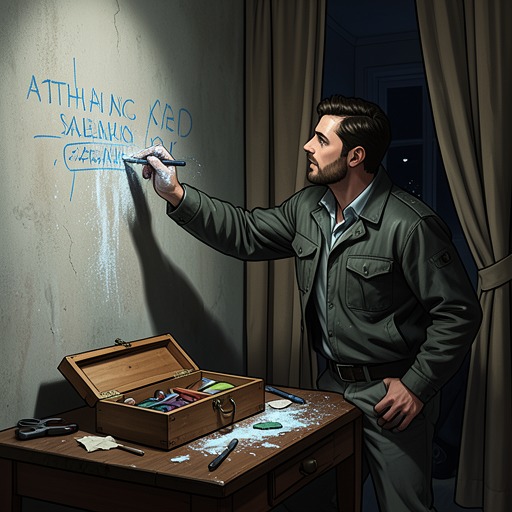
It is described as a huge coffin of banded oak. An embossed coat of arms rests on its lid, showing a rampant wolf, and beneath it appears the single identifying word “SARLINOV.” The name is the decisive sign that the object is not an anonymous burial chest. Its placement, decoration, and surrounding symbols give it the character of an altar or reliquary turned toward blasphemous worship. The coffin's material solidity contrasts with the shifting supernatural body hidden within it, while its seals preserve the appearance of confinement until the investigators decide to break them.
Discovery Beneath the Marsten House
Susan Norton and Mark Petrie reach the underground chamber while the house is unnaturally silent. They know they are not alone, although nothing immediately presents itself as an ordinary living presence. Mark carries a stake, and when they begin to examine the cellar he tells Susan to take her cross in her hand. She draws it from her blouse and finds comfort in its warmth; a faint luminous glow escapes between her fingers. The small religious object therefore stands against the enormous coffin not through physical size but through the faith invested in it.
The sight of the coffin confirms the truth Susan has been struggling to accept. The wolf crest and the name Sarlinov make the concealed chamber legible: the underground space is not merely an abandoned cellar but the vampire's protected habitation and ritual theater. The coffin gathers the house's buried history into one object. Its locked and sealed condition also gives the discovery a dangerous delay, because the truth can be seen before it can safely be acted upon.
Opening and Exposure to Light
In the original manuscript's deleted sequence, Ben Mears and Mark Petrie carry Sarlinov's coffin outside and set it on the wet autumn earth. They stand together before its locks and seals, and when they touch them the locks split with the sound of thin, snapping clapboards. The action turns the coffin from a hidden object into a battlefield. Its relocation matters because the investigators' weapon is not simply the stake or the breaking of the seals, but the natural light waiting beyond the Marsten House's subterranean darkness.
When the coffin opens, Sarlinov appears as a young man. His black hair is vibrant and lustrous, his skin glows with apparent life, his cheeks are ruddy, and his teeth show over full lips. The body contradicts the ordinary meaning of a coffin: rather than containing decay, it preserves a seductive imitation of health. Yet the appearance is conditional and temporary. As soon as the light strikes him, his eyes fly open, his chest draws breath, and his mouth opens on a writhing tongue and a mass of teeth. The coffin has preserved the vampire, but it cannot protect him once the seals are broken and daylight reaches the body.
Destruction and Material Meaning
The destruction occurs with terrifying speed but is rendered through a sequence of physical transformations. Sarlinov's skin yellows, coarsens, blisters, and cracks; his eyes film over and sink; his hair turns white and falls away; his body shrivels inside the dark suit. His lips recede until the mouth becomes a ring of jutting teeth, his fingernails blacken and drop off, and the fleshless skull continues to move as the clothing collapses around empty bones. The final image is not a clean disappearance but a grotesque conversion of apparent life into dressed, clicking remains and then dust.
That dissolution gives the coffin a second function. It first preserves the illusion that the dead can return intact, then frames the violent reversal through which the body's false vitality is exposed. The vessel is therefore both shelter and evidence, concealment and testimony. Its oak, bands, locks, seals, heraldry, and ritual setting make supernatural evil materially apprehensible; its opening allows the narrative to replace speculation with an irreversible physical consequence.
Narrative and Gothic Significance
The coffin's underground position links it to the Marsten House's accumulated evil and to the broader geography of Jerusalem's Lot, whose roads, wooded high ground, cemeteries, and social margins organize what the town can see and what it keeps below the surface. The town's ordinary map presents roads crossing at right angles and a nearly circular settlement, but the coffin supplies a hidden vertical map: beneath the familiar house lies a chamber where the town's apparent normality is inverted. Its darkness is not empty space; it is a storage place for history, ritual, and the returning dead.
The object also sharpens the novel's contrast between communal denial and direct knowledge. Jerusalem's Lot can treat national wars, local deaths, and civic crises as distant information, maintaining the conviction that nothing truly terrible can happen there. The coffin defeats that comfort by presenting evil as a solid, named, decorated thing. At the same time, the manuscript's daylight sequence makes the object part of a larger pattern: darkness sustains the vampire, while light exposes the difference between a living body and an imitation of life. Barlow's coffin thus concentrates the gothic logic of the Marsten House into one unforgettable object—sealed, ritualized, and apparently inert until opened, after which it becomes the stage for the destruction of the power it concealed.